Automotive electronics have long been faced with temperature fluctuations, vibrations, humidity and heat, and electrical shocks. Component selection cannot only look at normal temperature rated parameters. AEC-Q200 provides a unified stress testing qualification framework for passive components. The more critical issue in the project is: whether the specific material number has been verified according to applicable requirements, and whether it can withstand the real working conditions of this project.
1. What exactly is AEC-Q200?
AEC is the abbreviation of Automotive Electronics Council. The official name of AEC-Q200 is Stress Test Qualification for Passive Components, which is the passive component stress test qualification verification specification. This article is based on the AEC-Q200 Rev E base document released on March 20, 2023.
It is mainly aimed at passive components such as resistors, capacitors, and inductors. The commonly referred to as "AEC-Q200 certification" is an abbreviation for ease of communication; during procurement audits, suppliers should be required to provide qualification verification information corresponding to material numbers, applicable tests and results, and the promotional page cannot be regarded as a general certificate issued by an independent organization. AEC-Q200 does not mean that the entire vehicle or circuit board has passed reliability verification.
Three things need to be distinguished: AEC-Q200 describes device qualification; IATF 16949 focuses on an organization's automotive industry quality management system; and PPAP is production part approval information in customer projects. The three can cooperate with each other but cannot replace each other.
2. How does the test correspond to the actual risk of failure?
AEC-Q200 Rev E lists applicable tests, conditions, sample sizes, and qualification requirements by component category. High-temperature storage, temperature cycling, humidity-related tests, working life, vibration, mechanical shock, plate bending and terminal strength, etc. are common check items for engineers; electrical surge or electrostatic tests should be judged according to the specific device and the corresponding appendix. Not every passive component needs to undergo the exact same set of tests.
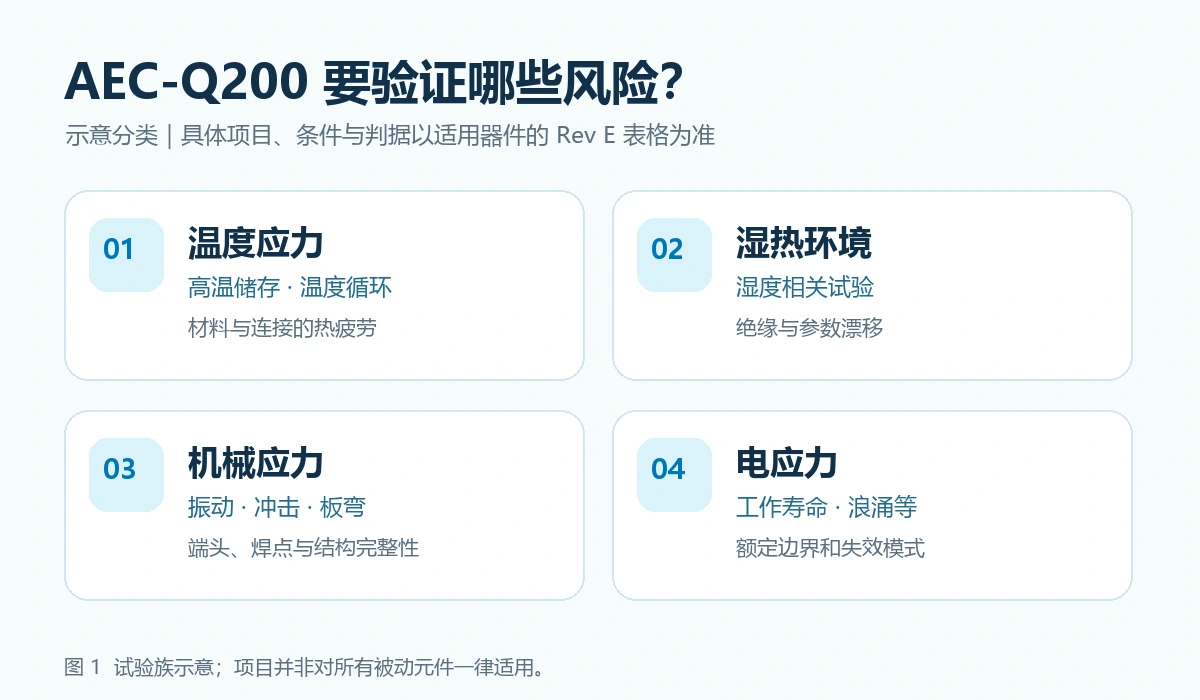
| risk category | Typical checkpoints | Questions to ask when selecting |
|---|---|---|
| Temperature and humidity | Temperature cycling, high temperature storage, humidity stress | Do maximum hot spot temperatures and hot and cold cycles fall within rated ranges? |
| mechanical stress | Vibration, impact, plate bending, terminal strength | Do PCB deformations, mounting locations and soldering processes increase the risk of cracking? |
| Electrical stress and life | Load life, applicable surge tests | Are continuous power, peak voltage and pulse energy derated? |
| Parameter stability | Electrical performance measurements before and after the test | Does the resistance, capacitance or inductance drift meet the overall machine error budget? |
When reading a report, don't just count the "passed" items. First confirm the applicable items, and then check the test method, conditions, sample size, number of failures, judgment limits and parameter changes before and after the test. If the supplier cites an older version of the specification, it should confirm whether the customer project accepts this version and explain the differences with Rev E.
3. Five-step closed-loop selection of automotive components
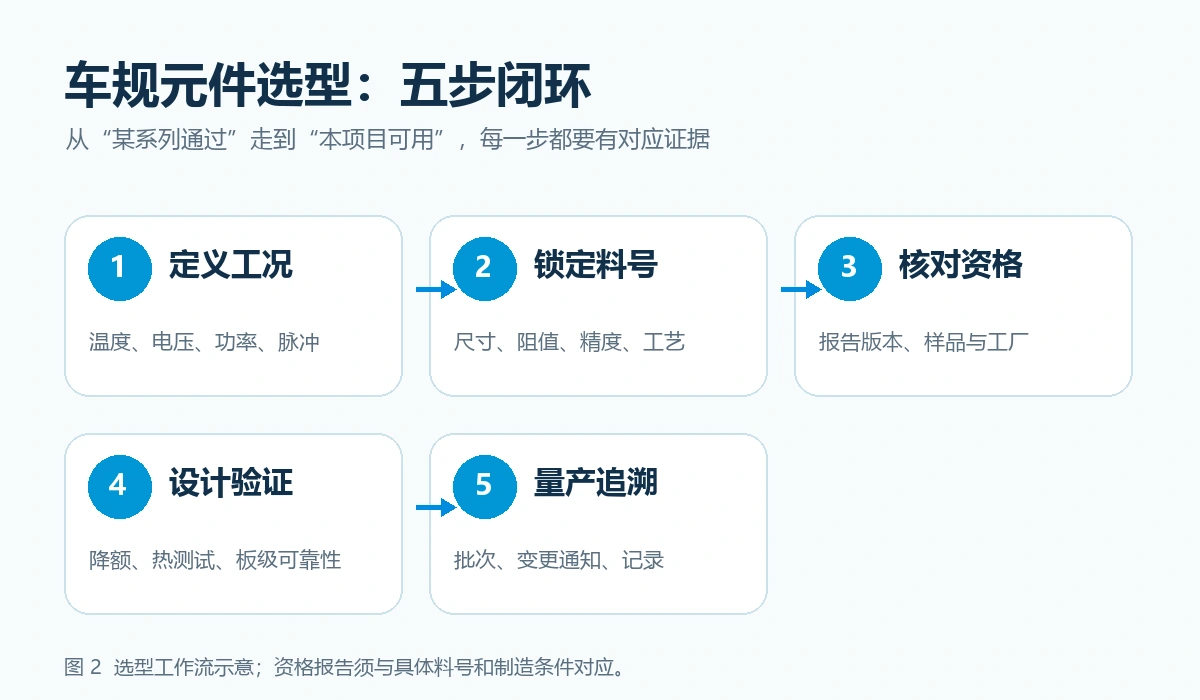
- 1. Define real operating conditions: list ambient temperature, device hot spot temperature, continuous voltage and current, power, surge/pulse waveform, duty cycle, expected life, and installation location.
- 2. Lock the specific material number: implement the resistance value, tolerance, temperature coefficient, rated power, maximum operating voltage, package size, termination structure and manufacturing process into the complete ordering material number.
- 3. Check qualification evidence: Request the AEC-Q200 report or customer-approved summary and check the specification version, part number coverage, sample source, manufacturer, test date and results.
- 4. Verify in the circuit: Derate according to the installation and heat dissipation conditions in the data sheet, and complete the real board thermal test, functional test and necessary board-level reliability verification.
- 5. Leave a traceability chain: Save approved material numbers, specification versions, qualification reports, batch records and PCN (Product Change Notification) requirements.
The same series name does not mean that every resistance value, size or production location within the series is covered by the same report. When materials, processes or factory locations change, revalidation and change notification mechanisms should also be confirmed.
4. Take car-grade resistors as an example: look at four more items than "is the power sufficient?"
- Temperature Rise and Derating: Test conditions for rated power may differ significantly from heat dissipation in a sealed controller, and hot spot temperatures should be measured under worst-case conditions.
- Pulse capability: In precharge, discharge, braking or surge scenarios, the single energy, peak power, repetition frequency and voltage limits must be checked with actual waveforms, not just continuous power.
- Accuracy drift: The sampling resistor needs to simultaneously evaluate the initial tolerance, temperature coefficient, self-heating and drift after long-term load.
- Mechanical adaptation: For large size chip resistors and board edge mounting locations, special attention should be paid to PCB warpage, solder joints, and termination structures.
Passing AEC-Q200 does not imply long-term use at full rating. The deliverable for model selection should be a correspondence table of "working conditions - material number - qualification report - design verification", which is more convenient for the R&D, procurement and quality teams to review together than simply labeling "vehicle grade".
5. Procurement Review Checklist
- Is the qualification information clear to the complete part number, specification range and manufacturer?
- Is the AEC-Q200 version noted, along with applicable project conditions and results?
- Do the datasheet temperature, power, voltage, pulse, and mechanical boundaries cover project conditions?
- Are there actual board tests, derating basis, change notifications and batch traceability arrangements?
The AEC-Q200 is the starting point for selection. Corresponding the verification evidence to specific devices and specific working conditions is a more reliable method for selecting automotive components.
References
- AEC official document directory: http://www.aecouncil.com/AECDocuments.html
- AEC-Q200 Rev E base document (2023-03-20): http://www.aecouncil.com/Documents/AEC_Q200_Rev_E_Base_Document.pdf
- AEC-Q200-005 Rev A Plate bending/terminal bonding strength test: http://www.aecouncil.com/Documents/AEC_Q200-005A.pdf
The illustrations in this article are original illustrations of INLANX and are not standard original images; please refer to applicable standards and customer requirements for specific criteria.
Contact us to discuss your requirements
Whether you need a standard resistor or a custom solution for a specialized industrial application, our team is ready to help. Contact us for detailed advice, technical consultation, or a factory visit.